| Without wings I wont fly. Without you, I'll die. |
|
|
|
Monday, May 19, 2008 COLOURED. ANDY WARHOL 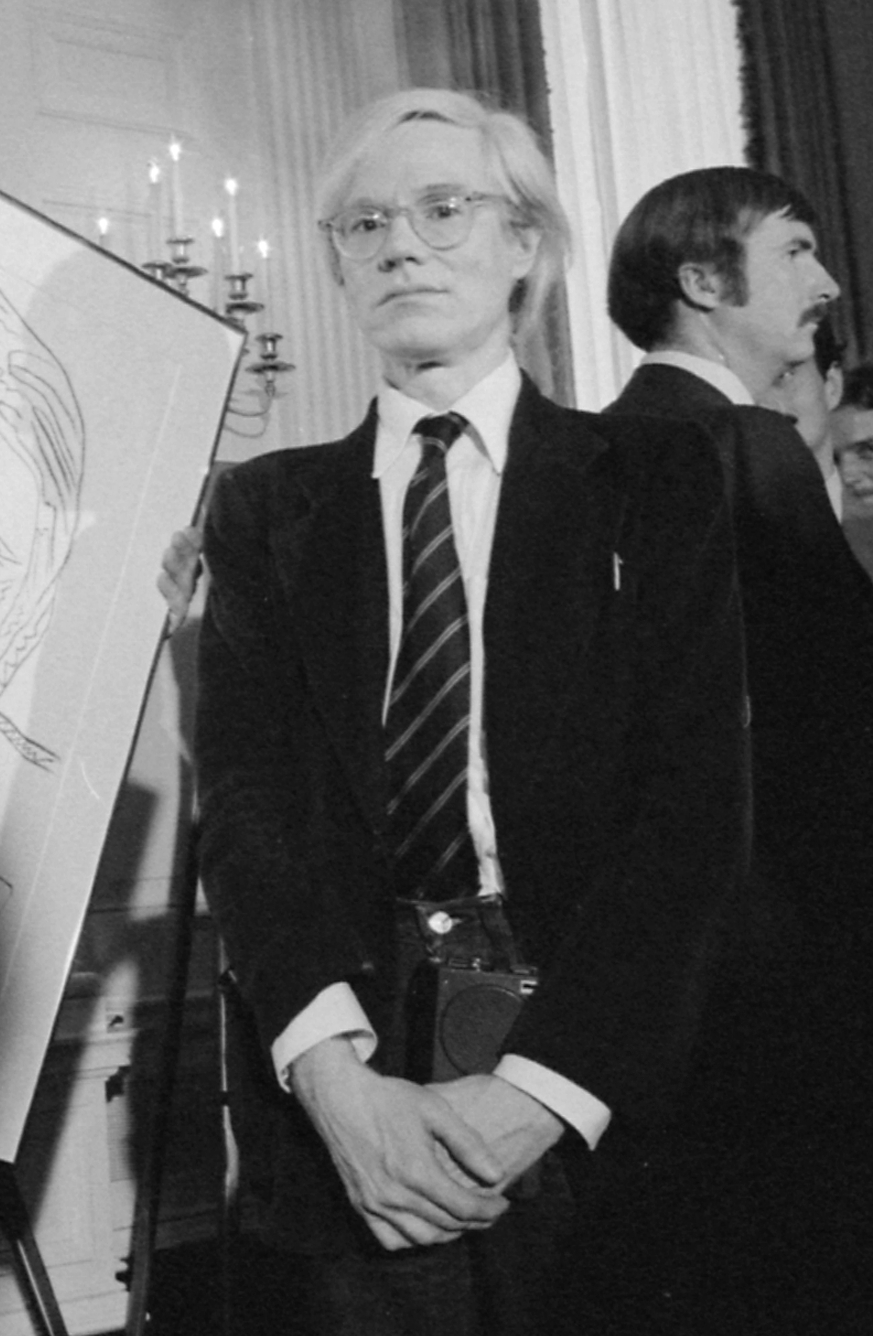 Andrew Warhola (August 6, 1928 – February 22, 1987), better known as Andy Warhol, was an American artist and a central figure in the movement known as Pop art. After a successful career as a commercial illustrator, Warhol became famous worldwide for his work as a painter, an avant-garde filmmaker, a record producer, an author, and a public figure known for his membership in wildly diverse social circles that included bohemian street people, distinguished intellectuals, Hollywood celebrities and wealthy aristocrats. A controversial figure during his lifetime (his work was often derided by critics as a hoax, or "put-on"), Warhol has been the subject of numerous retrospective exhibitions, books, feature and documentary films since his death in 1987. Andy Warhol was born in Pittsburgh, Pennsylvania.[1] Andy was the third child of his parents, Ondrej (Andrew) Warhola (the surname was spelled Varchola in Europe, and was modified after immigrating to America) and Julia Warhola, née Ulja (Julia) Justyna Zavacky.[citation needed] His parents were working-class immigrants of Lemkos-Rusyns (Ruthenian) ethnicity from Mezőlaborc, now Medzilaborce, of Austro-Hungarian Empire (now in northeast Slovakia). Warhol's father migrated to the USA in 1914, while his mother joined him in 1921, after the death of Andy Warhol's grandparents. Warhol's father worked in a coal mine. The family lived at 55 Beelen Street and later at 3252 Dawson Street in the Oakland neighborhood of Pittsburgh.[2]. The family was Byzantine Catholic and attended St. John Chrysostom Byzantine Catholic Church. Andy Warhol has two older brothers John and Paul. In third grade Warhol had St. Vitus' dance, a nervous system disease causing involuntary movements which is believed to be a complication of scarlet fever, and which causes blotchiness in skin pigmentation of his skin. He became somewhat of a hypochondriac, developing a fear of hospitals and doctors. Often bed-ridden as a child, he became an outcast among his school-mates and bonded with his mother very strongly (Guiles, 1989). When in bed he drew, listened to the radio and collected pictures of movie stars around his bed. Warhol later described this period as very important in the development of his personality, skill-set and preferences. Warhol showed an early artistic talent and studied commercial art at the School of Fine Arts at Carnegie Institute of Technology in Pittsburgh (now Carnegie Mellon University). In 1949, he moved to New York City and began a successful career in magazine illustration and advertising. During the 1950s, he gained fame for his whimsical ink drawings of shoe advertisements. These were done in a loose, blotted ink style, and figured in some of his earliest showings in New York at the Bodley Gallery. With the concurrent rapid expansion of the record industry and the introduction of the vinyl record, Hi-Fi, and stereophonic recordings, RCA Records hired Warhol, along with another freelance artist, Sid Maurer, to design album covers and promotional materialsPaintings By the beginning of the 1960s, Warhol was a very successful commercial illustrator. His detailed and elegant drawings for I. Miller shoes were particularly popular. These illustrations consisted mainly of "blotted ink" drawings (or monoprints), a technique which he applied in much of his early art. Although many artists of this period worked in commercial art, most did so discreetly. Warhol was so successful, however, that his profile as an illustrator seemed to undermine his efforts to be taken seriously as an artist. In the early 1960s, Warhol tried to exhibit some of his drawings using these techniques in a gallery, only to be turned down. He began to rethink the relationship between his commercial work and the rest of his art. Instead of treating these things as opposites, he merged them, and began to take commercial and popular culture more explicitly as his topic. Pop Art was an experimental form that several artists were independently adopting; some of these pioneers, such as Roy Lichtenstein, would later become synonymous with the movement. Warhol, who would become famous as the "Pope of Pop", turned to this new style, where popular subjects could be part of the artist's palette. His early paintings show images taken from cartoons and advertisements, hand-painted with paint drips. Those drips emulated the style of successful abstract expressionists (such as Robert Rauschenberg). Eventually, Warhol pared his image vocabulary down to the icon itself—to brand names, celebrities, dollar signs—and removed all traces of the artist's "hand" in the production of his paintings. To him, part of defining a niche was defining his subject matter. Cartoons were already being used by Lichtenstein, typography by Jasper Johns, and so on; Warhol wanted a distinguishing subject. His friends suggested he should paint the things he loved the most. In his signature way of taking things literally, for his first major exhibition he painted his famous cans of Campbell's Soup, which he claimed to have had for lunch for most of his life. He loved celebrities, so he painted them as well. From these beginnings he developed his later style and subjects. Instead of working on a signature subject matter, as he started out to do, he worked more and more on a signature style, slowly eliminating the hand-made from the artistic process. Warhol frequently used silk-screening; his later drawings were traced from slide projections. Warhol went from being a painter to being a designer of paintings. At the height of his fame as a painter, Warhol had several assistants who produced his silk-screen multiples, following his directions to make different versions and variations. Warhol produced both comic and serious works; his subject could be a soup can or an electric chair. Warhol used the same techniques—silkscreens, reproduced serially, and often painted with bright colors—whether he painted celebrities, everyday objects, or images of suicide, car crashes, and disasters (as part of a 1962-1963 series called "Death and Disaster"). The "Death and Disaster" paintings (such as "Red Car Crash", "Purple Jumping Man", "Orange Disaster") transform personal tragedies into public spectacles, and signal the use of images of disaster in the then evolving media. The unifying element in Warhol's work is his deadpan Keatonesque style—artistically and personally affectless. This was mirrored by Warhol's own demeanor, as he often played "dumb" to the media, and refused to explain his work. The artist was famous for having said that all you need to know about him and his works is already there, "on the surface." Warhol's work as a Pop Artist has always had conceptual aspects. His series of do it yourself paintings and Rorschach blots are intended as pop comments on art and what art could be. His cow wallpaper (literally, wallpaper with a cow motif) and his oxidation paintings (canvases prepared with copper paint that was then oxidized with urine) are also noteworthy in this context. Equally noteworthy is the way these works—and their means of production—mirrored the atmosphere at Andy's New York "Factory." Biographer Bob Colacello provides some details on Andy's "piss paintings":.[3](http://en.wikipedia.org/wiki/Andy_Warhol) 8:16 PM Sunday, May 11, 2008 COLOURED. defination of 'semiotics'  a philosophical theory of the functions of signs and symbols(http://dict.iciba.com); Semiotics is a science of signs and/or sign systems(Eugene Gorny); Semiotic is an application of linguistic methods to objects other than natural language(Eugene Gorny); Semiotics is the study of signs and signifying practices(http://atheism.about.com/) After all the search of the defination of the word'semitics'. I found it is dealt with visual communication. It sees every single sign and symbol as a language especially those appears in media like advertisements and films. In other word, it is reading media, it is transforming the signs in a way to let people to understand the meaning of it. It is a belief that every sign convey a message. Over all . I summarize the defination of 'semiotics 'in my own word:'the study of signs and symbols in a way to translate them into normal language to achieve the purpose of visual communication.' 11:17 PM |